DR ANTHONY MELVIN CRASTO,WorldDrugTracker, helping millions, A 90 % paralysed man in action for you, I am suffering from transverse mylitis and bound to a wheel chair, With death on the horizon, nothing will not stop me except God................DR ANTHONY MELVIN CRASTO Ph.D ( ICT, Mumbai) , INDIA 25Yrs Exp. in the feld of Organic Chemistry,Working for GLENMARK GENERICS at Navi Mumbai, INDIA. Serving chemists around the world. Helping them with websites on Chemistry.Million hits on google, world acclamation from industry, academia, drug authorities for websites, blogs and educational contribution

Thursday, 23 July 2015

[(2-{2-[2-(Bis-methoxycarbonylmethylamino)phenoxy]ethoxy}-4-benzimidazole-phenyl)methoxycarbonylmethylamino]acetic acid methyl ester


[(2-{2-[2-(Bis-methoxycarbonylmethylamino)phenoxy]ethoxy}-4-benzimidazole-phenyl)methoxycarbonylmethylamino]acetic acid methyl ester


1-(2-Chloroethoxy)-2-nitrobenzene 1

 
1-Bromo-2-chloroethane (4.30 g, 0.03mol) and K2CO3 (2.07 g, 0.015 mol) were added to a solution of 2-nitrophenol (1.39 g, 0.01mol) in DMF (8 mL) at room temperature, the reaction was kept at 120 ºC for 5 h, cooled and diluted with EtOAc (20 mL), then washed with water (3 × 10 mL). The organic layer was collected and concentrated under vacuum, recrystallized in MeOH to give light yellow solid 1. Yield 93%; 

m. p. 36-37 ºC; 

1H NMR (CDCl3, 400 MHz) d 7.85 (m, 1H), 7.56 (m, 1H), 7.10 (m, 2H), 4.40 (t, 2H, J 12 Hz), 3.86 (t, 2H, 12 Hz); 

IR ν/cm-1 2926, 2875, 1608, 1522, 1343, 1276, 1026, 745, 667.


1-Nitro-2-[2-(2-nitrophenoxy)ethoxy]benzene 2
 

To a solution of 1 (2.01 g, 0.01 mol) in DMF (10 mL) at room temperature, 2-nitrophenol (1.39 g, 0.01 mol) and K2CO3 (2.50 g, 0.018 mol) were added. The reaction mixture was stirred at 140 ºC for 4 h, cooled and poured into cold water (20 mL). The formed yellow solid was filtered and washed with water (3 × 5 mL). The crude product was recrystallized in MeOH to give yellow solid 2. Yield 95%; 

m.p. 168-169 ºC; 

1H NMR (CDCl3, 400 MHz) δ 7.83 (d, 2H, J 8 Hz), 7.57 (t, 2H, J 8 Hz), 7.24 (t, 2H, J 8 Hz), 7.08 (t, 2H, J 8 Hz), 4.54 (s, 4H); 

IRν/cm-1 3051, 2956, 2931, 1606, 1582, 1518, 1359, 1278, 1159, 1090, 744, 671.


2-[2-(2-Aminophenoxy)ethoxy]benzenamine 3
 
Iron powder (3.36 g, 0.06 mol), concentrated hydrochloric acid (0.2 mL), and anhydrous ethanol (10 mL) were added into a dried three-necked flask equipped with a magnetic stirrer. When the mixture was heated to boiling,2 (3.04 g, 0.01mol) was added in three portions. The mixture was refluxed for 4 h, and then made alkaline to litmus by addition of 15% alcoholic potassium hydroxide solution, the iron powder was removed by filtration afterwards. Into the filtrate, 6 mol L-1 sulfuric acid was added and white precipitate was obtained. After filtration, the precipitate was dissolved in 40 mL of warm water and made alkaline to pH = 8 with saturated sodium hydroxide solution. The generated light yellow solid was collected and recrystallized in MeOH to give white solid 3. Yield 88%; 

m.p. 116-117 ºC;  

1H NMR (CDCl3, 400 MHz) δ 6.98 (m, 8H), 4.36 (s, 4H), 3.82 (s, 4H); 

IR ν/cm-1 3432, 3355, 3059, 2934, 1612, 1507, 1461, 1276, 1217, 941, 739.


1,2-Bis(2-aminophenoxy)ethyl-N,N,N',N'-acetic acid methyl ester 4
Compound 3 (2.44 g, 0.01 mol) was dissolved in MeCN (10 mL), then (i-Pr)2NEt (6 mL) and methyl bromoacetate (3 mL) were added to the mixture with stirring. The reaction mixture was refluxed for 24 h. After the reaction, the mixture was cooled down, poured into EtOAc (20 mL), and filtered to remove the generated white solid. The combined EtOAc filtrates were concentrated in vacuo to give an oily solid, then adding a little methanol, white solid was generated, filtered, air dried and recrystallized in MeOH to give white solid 4. Yield 87%; m.p. 94-95 ºC; 1H NMR (CDCl3, 400 MHz) δ 6.85 (m, 8H), 4.27 (s, 4H), 4.15 (s, 8H), 3.56 (s, 12H); IRν/cm-1 3067, 2993, 2951, 2921, 2888, 1748, 1596, 1509, 1173, 742, 706.


[(2-{2-[2-(Bis-methoxycarbonylmethylamino)-5-methylphenoxy]ethoxy}-4-formyl-5-methyl-phenyl)methoxycarbonylmethylamino]acetic acid methyl ester 5
POCl3 (2.4 mL) was added dropwise over 40-45 min into a dry three-necked flask which contained anhydrous DMF (20 mL). The POCl3/DMF mixture was stirred at room temperature for 1-2 h and added dropwise into a DMF (20 mL) solution of compound 4 (5.32 g, 0.01mol) afterwards. The reaction mixture was heated at 75 ºC for 4 h, concentrated in vacuo, and then poured into ice water. The suspension was filtered and purified by column chromatography (silica gel, V(EtOAc):V(hexane) = 1:1 as eluent) to afford white solid 5.20 Yield 85%; m.p. 131-132 ºC; 1H NMR (CDCl3, 400 MHz) δ 9.80 (s, 1H), 7.38 (m, 2H), 6.86 (m, 4H), 6.76 (d, 1H, 8.3 Hz), 4.31 (m, 2H), 4.27 (m, 2H), 4.24 (s, 4H), 4.15 (s, 4H), 3.57 (s, 6H), 3.56 (s, 6H); 13C NMR (CDCl3, 101 MHz) δ190.5, 171.9, 171.2, 150.1, 149.6, 145.0, 139.3, 129.9, 126.7, 122.2, 121.6, 116.5, 112.9, 110.5, 77.3, 77.0, 76.7, 67.3, 66.6, 53.4, 53.2, 52.0, 51.9, 51.6; IR ν/cm-1 3015, 2954, 2928, 1746, 1681, 1593, 1509, 1245, 1164, 747; HRMS calcd. for C27H32N2O11: 560.2006, (M+Na)+ calcd.: 583.1898, (M+Na)+ found: 583.1894.


[(2-{2-[2-(Bis-methoxycarbonylmethylamino)phenoxy]ethoxy}-4-benzimidazole-phenyl)methoxycarbonylmethylamino]acetic acid methyl ester 6

A mixture of 1,2-phenylenediamine (0.11 g, 1 mmol), compound 5 (0.56 g, 1 mmol), H2O2 (30%, 4 mmol, 0.4 mL) and Fe(NO3)3·9 H2O (0.04 g, 0.1 mmol) was heated at 50 ºC for 30 min. After completion of the reaction, the reaction mixture was dissolved in EtOH (10 mL) and then poured into ice-water (30 mL). The pure solid product was filtered, washed with ice-water, dried and subsequently purified by column chromatography (silica gel, V(EtOAc):V(hexane) = 1:1 as eluent)21,22 to afford white solid 6. Yield 80%; 
m.p. 72-73 ºC; 

IR (KBr, cm-1) 3505 (νN-H), 3033 (ν=C-H), 2906 (νC-H), 1743 (νC=O), 1509 (νC=C), 1478 (νC=C), 1170 (νC-O), 746 (δ=C-H); 

1H NMR (400 MHz, CDCl3δ 7.68 (d, 1H, J 8 Hz), 7.56 (s, 3H), 7.17 (s, 2H), 6.87 (m, 2H), 6.83 (m, 1H), 6.70 (m, 2H), 4.13 (s, 8H), 3.91 (m, 3H), 3.85 (s, 2H), 3.54 (s, 6H), 3.51 (s, 6H); 

13C NMR (100 MHz, CDCl3δ 172.2, 171.7, 152.2, 150.2, 149.9, 140.8, 138.7, 122.4, 121.4, 120.3, 118.9, 118.2, 112.8, 111.3, 77.4, 77.1, 76.8, 66.9, 66.5, 53.4, 53.3, 51.8; 

HRMS calcd. for C33H36N4O10: 648.2431, (M+H)+ calcd.: 649.2504, (M+H)+ found: 649.2487.

The structure of 6 was characterized by IR, ESI-HRMS, PXRD, 1H and 13C NMR. IR spectrum of 6 shows typical secondary amine absorption (νN-H 3506 cm-1), aromatic absorption (ν=C-H 3033 cm-1νC=C 1510, 1478 cm-1;δ=C-H 746 cm-1) and ester absorption (νC=O 1743 cm-1νC-O 1171 cm-1). The HRMS m/z value, 1H and 13C NMR chemical shifts are in accordance with the structure of 6

http://www.scielo.br/scielo.php?script=sci_arttext&pid=S0103-50532014000100014&lng=en&nrm=iso&tlng=en


1H NMR PREDICT


13 C NMR PREDICT


Journal of the Brazilian Chemical Society

Print version ISSN 0103-5053

J. Braz. Chem. Soc. vol.25 no.1 São Paulo Jan. 2014

http://dx.doi.org/10.5935/0103-5053.20130276 

ARTICLE

Structural study and fluorescent property of a novel organic microporous crystalline material


Zhao Cheng; Bingqin Yang*; Meipan Yang; Binglin Zhang
Key Laboratory of Synthetic and Natural Functional Molecule Chemistry of Ministry of Education, College of Chemistry and Materials Science, Northwest University, 710069 Xi'an, China

सुकून उतना ही देना प्रभू, जितने से जिंदगी चल जाये। औकात बस इतनी देना, कि औरों का भला हो जाये।
DRUG APPROVALS BY DR ANTHONY MELVIN CRASTO …..FOR BLOG HOME CLICK HERE

Join me on Linkedin

View Anthony Melvin Crasto Ph.D's profile on LinkedIn

Join me on Facebook FACEBOOK
Join me on twitterFollow amcrasto on Twitter
Join me on google plus Googleplus

 amcrasto@gmail.com

09b37-misc2b027LIONEL MY SON
He was only in first standard in school when I was hit by a deadly one in a million spine stroke called acute transverse mylitis, it made me 90% paralysed and bound to a wheel chair, Now I keep him as my source of inspiration and helping millions, thanks to millions of my readers who keep me going and help me to keep my son happy
सुकून उतना ही देना प्रभू, जितने से
जिंदगी चल जाये।
औकात बस इतनी देना,
कि औरों का भला हो जाये।

//////

Wednesday, 22 July 2015

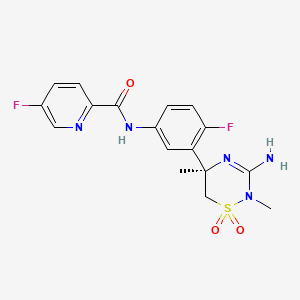
Verubecestat, MK-8931


Verubecestat.pngV1

Verubecestat (MK-8931)

Merck Alzheimer's drugs Verubecestat (MK-8931) is an oral β- amyloid precursor protein cleaving enzyme (BACE1 or β-secretase enzyme) inhibitor, is currently in Phase III clinical trials

Verubecestat MK 8931, MK-8931, SCH 900931  
2-Pyridinecarboxamide, N- (3 - ((5R) -3-amino-5,6-dihydro-2,5-dimethyl-1 , 1-dioxido-2H-1,2,4-thiadiazin-5-yl) -4-fluorophenyl) -5-fluoro- N-[3-[(5R)-3-amino-2,5-dimethyl-1,1-dioxo-6H-1,2,4-thiadiazin-5-yl]-4-fluorophenyl]-5-fluoropyridine-2-carboxamide  
CAS : 1286770-55-5  
Mechanism: Oral β- amyloid precursor protein cleavage enzyme (BACE) inhibitors Indications: Alzheimer's disease Development progress: phase III clinical  

Companies: Merck

Verubecestat (MK-8931) is a small-molecule inhibitor of beta-secretase cleaving enzyme (BACE) 1 and BACE2 in development by Merck for the treatment of Alzheimer's Disease. MK-8931 is a beta-secretase 1 (BACE1) inhibitor in phase III development for the treatment of amnestic mild cognitive impairment (aMCI) due to Alzheimer's disease at Merck & Co. The company is also conducting phase II/III trials for the treatment of Alzheimer's type dementia.
Smiles: C [C @] 1 (CS (= O) (= O) N (C (= N1) N) C) c2cc (ccc2F) NC (= O) c3ccc (cn3) F  

COSY PREDICT

  V0COSY
https://www.google.co.in/patents/CN102639135A?cl=en  

Scheme 3b:
Figure CN102639135AD00931
The amine A (Scheme 3a, step 4) (13.7 g) in n-butanol (150 mL) was added a slurry solution of cyanogen bromide (5M, in MeCN). The resulting mixture was heated to reflux for 4 hours. The mixture was concentrated to 1/3 of original volume. To this mixture was added Et20 (200 mL). The resulting solid was removed by filtration, and the solid was washed with Et20 (2x). The solid was partitioned between EtOAc and saturated Na2CO3 (aq). The aqueous layer was extracted with EtOAc (3x). The combined organic layers were washed with brine, dried over Na2SO4, filtered and concentrated to give 10.6 g Scheme 10:
Figure CN102639135AD00982
The nitro compound (Scheme 3b) (2. 50 g, 6. 0 mmol) of Et0H (150 mL) was degassed (To this solution was bubbled with nitrogen time 3 min). To this solution was added Pd / C (10% w / w, 50% water, 698 mg). The mixture was placed in a nitrogen atmosphere. Exhaust, and backfilled with H2 (3x). The obtained mixture at room temperature, followed by stirring under H2 balloon for 2 hours. Bubbling nitrogen gas, and the mixture was purged, filtered through Celite, and concentrated.Small plug filtered through a silica gel column, eluting with EtOAc, and the product was purified to give the aniline (2. 2g, 97%).

   
SEE PATENT http://www.google.co.in/patents/WO2011044181A1?cl=en


  veb  


SNAPSHOT WP_000366  

SYNTHESIS CONSTRUCTION
  V9
AND
 V8
ON RXN WITH WITH BuLi GIVES V7THIS GIVES
 V6
THIS ON TREATMENT WITH BrCN V5


ON BOC2O TREATMENT GIVES V4

GIVES ON HYDGN
 V2
 REACTION WITH
 V3
 GIVES FINAL COMPD Verubecestat V1


 1H NMR PREDICT V0 V01H GRAPH V01H 13C NMR PREDICT

  V013C GRAPH V013C

Updated.......WATCH OUT FOR MORE
https://www.google.co.in/patents/US8729071?cl=en


Steps 1-4:
These steps were performed using similar procedures to those described in steps 1-4 of Scheme 1a.
Step 5:
To a solution of the amine from step 4 (10.5 g, 36 mmol) in CH2Cl2 (200 mL) was added benzoylisothiocyanate (4.3 mL, 1.1 eq.). The resulting solution was stirred at RT for 2.5 days. Additional benzoylisothiocyanate (0.86 mL, 0.2 eq.) was added and the solution was stirred at RT for an additional 2 hours. The solution was then concentrated in vacuo.
A portion of this material (6.5 g, ˜14 mmol) was dissolved in MeOH (200 mL). To this solution was added Na2CO3 (s) (1.52 g, 14 mmol). The resultant mixture was stirred at RT for 45 min. After that time, a slight excess of HOAc was added to the solution. The mixture was then concentrated. The residue was partitioned between CH2Cl2 and ½ sat. NaHCO3 (aq.). The aqueous layer was extracted with CH2Cl2 (3×). The combined organic layers were dried over Na2SO4, filtered and concentrated. The thiourea (˜4.9 g) was carried onto the next reaction without further purification.
Step 6:
Example 15 was prepared using a method similar to that described in Scheme 1a step 6.
To a shiny of amine A (Scheme 3a step 4) (13.7 grams) in n-butanol (150 mL) was added a solution of cyanogen bromide (5M in MeCN). The resultant mixture was heated to reflux for 4 hours. The mixture was concentrated to ⅓ of the original volume. To the mixture was added Et2O (200 mL). The resultant solid was removed via filtration and the solid was washed with Et2O (2×). The solid was partitioned between EtOAc and sat. Na2CO3 (aq.). The aqueous layer was extracted with EtOAc (3×). The combined organic layers were washed with brine, dried over Na2SO4, filtered and concentrated to afford 10.6 grams of Ex. 15. This material was converted to the t-butyl carbamate using a procedure similar to that described in Scheme 3.
Step 7:
A mixture of the bromide (3.00 g, 6.92 mmol), benzophenone imine (1.39 mL, 8.30 mmol), Pd2(dba)3 (0.634 g, 0.692 mmol), John-Phos (0.413 g, 1.38 mmol), sodium tert-butoxide (2.13 g, 22.1 mmol), and toluene (51 mL) was degassed (vacuum/N2). The mixture was then stirred at 65° C. under nitrogen for 3 h. After this time, the reaction mixture was cooled to room temperature and filtered through a pad of Celite and rinsed with ethyl acetate (100 mL). The filtrate was concentrated under reduced pressure. The residue was then dissolved in methanol (76 mL) and the resulting solution was charged with hydroxyl amine hydrochloride (2.16 g, 31.1 mmol) and sodium acetate (2.55 g, 31.1 mmol). The reaction mixture was stirred at room temperature for 40 min. After this time, the reaction mixture was concentrated under reduced pressure. The resulting residue was dissolved in ethyl acetate (200 mL) and washed with saturated aqueous sodium bicarbonate (100 mL), water (100 mL), and brine (100 mL). The organic layer was then dried over anhydrous sodium sulfate, filtered, and concentrated under reduced pressure. The residue was purified by column chromatography (silica, 0-100% ethyl acetate/heptane) to afford the amino pyridine (0.880 g, 34%).
To a flame-dried flask was added a pyridyl bromide (Table IIb, Entry 15, 1.5 g, 3.3 mmol), Pd2(dba)3 (305 mg, 0.3 mmol), (2-biphenyl)di-tert-butylphosphine (200 mg, 0.7 mmol), sodium tert-butoxide (1.02 g, 0.011 mmol), benzophenone imine (670 ul, 4 mmol), and toluene (21 mL). The mixture was evacuated under vacuum and back-filled with N2 (3×). The mixture was stirred at 60° C. for 1 h. After filtration through celite, the filtrate was concentrated. The crude residue was dissolved in 36 mL of methanol, and hydroxyl amine hydrochloride (458 mg, 6.6 mmol) and sodium acetate (541 mg, 6.6 mmol) were added. The reaction was stirred for 35 min and then quenched with saturated aqueous sodium bicarbonate. The mixture was extracted with ethyl acetate, and the combined organic portions were dried over magnesium sulfate and concentrated. The crude residue was purified by a flash silica column (50% ethyl acetate/hexane) to get an aminopyridine product (730 mg, 68%).
A solution of the nitro compound (Scheme 3b) (2.50 g, 6.0 mmol) in EtOH (150 mL) was degassed by bubbling N2 through the solution for 3 min. To this solution was added Pd/C (10% w/w, 50% H2O, 698 mg.). The mixture was placed under an atmosphere of N2. The atmosphere was evacuated and back-filled with H2 (3×). The resulting mixture was stirred at RT under a H2 balloon for 2 h. The mixture was purged by bubbling N2 through it, filtered through Celite and concentrated. The product was purified by filtering through a small plug of silica gel column eluting with EtOAc to afford the aniline (2.2 g, 97%).

ENTRY 25 MH+: 410.0, HPLC1.79 min, LCMSMETHOD D
Method D:
  • Column: Agilent Zorbax SB-C18 (3.0×50 mm) 1.8 uM
Mobile phase: A: 0.05% Trifluoroacetic acid in water
    • B: 0.05% Trifluoroacetic acid in acetonitrile
Gradient: 90:10 (A:B) for 0.3 min, 90:10 to 5:95 (A:B) over 1.2 min, 5:95 (A:B) for 1.2 min.
Flow rate: 1.0 mL/min
UV detection: 254 and 220 nm
Mass spectrometer: Agilent 6140 quadrupole

सुकून उतना ही देना प्रभू, जितने से जिंदगी चल जाये। औकात बस इतनी देना, कि औरों का भला हो जाये।
DRUG APPROVALS BY DR ANTHONY MELVIN CRASTO …..FOR BLOG HOME CLICK HERE

Join me on Linkedin

View Anthony Melvin Crasto Ph.D's profile on LinkedIn

Join me on Facebook FACEBOOK
Join me on twitterFollow amcrasto on Twitter
Join me on google plus Googleplus

 amcrasto@gmail.com

09b37-misc2b027LIONEL MY SON
He was only in first standard in school when I was hit by a deadly one in a million spine stroke called acute transverse mylitis, it made me 90% paralysed and bound to a wheel chair, Now I keep him as my source of inspiration and helping millions, thanks to millions of my readers who keep me going and help me to keep my son happy
सुकून उतना ही देना प्रभू, जितने से
जिंदगी चल जाये।
औकात बस इतनी देना,
कि औरों का भला हो जाये।

///////