DR ANTHONY MELVIN CRASTO,WorldDrugTracker, helping millions, A 90 % paralysed man in action for you, I am suffering from transverse mylitis and bound to a wheel chair, With death on the horizon, nothing will not stop me except God................DR ANTHONY MELVIN CRASTO Ph.D ( ICT, Mumbai) , INDIA 25Yrs Exp. in the feld of Organic Chemistry,Working for GLENMARK GENERICS at Navi Mumbai, INDIA. Serving chemists around the world. Helping them with websites on Chemistry.Million hits on google, world acclamation from industry, academia, drug authorities for websites, blogs and educational contribution

Monday, 24 July 2017

3-Phenylpropionic acid


3-Phenylpropionic acid (2z) 1
1) Jiang, X.; Zhang, J.; Ma. S. J. Am. Chem. Soc. 2016, 138, 8344
Yield: 94% (142 mg), white solid. Melting point: 47-49 °C (lit.18 49 °C)
(18) Helavi, V. B.; Solabannavar, S. B.; Desai, U. V.; Mane, R. B. J. Chem. Research 2003, 3, 174.
1 H NMR (400 MHz, CDCl3) δ 7.34 – 7.17 (m, 5H), 2.97 (t, J = 7.8 Hz, 2H), 2.69 (t, J = 7.8 Hz, 2H).
13C NMR (101 MHz, CDCl3) δ 179.82, 140.28, 128.71, 128.41, 126.52, 35.64, 30.73

1H AND 13C NMR PREDICT

Aerobic Oxidation of Diverse Primary Alcohols to Carboxylic Acids with a Heterogeneous Pd–Bi–Te/C (PBT/C) Catalyst

Department of Chemistry and Department of Chemical and Biological Engineering, University of Wisconsin-Madison, Madison, Wisconsin 53706, United States
Org. Process Res. Dev., Article ASAP
DOI: 10.1021/acs.oprd.7b00223
 
Maaz Ahmed

Maaz Ahmed

PhD Candidate in the Stahl Lab at University of Wisconsin-Madison

Image result for Shannon S. Stahl Wisconsin-Madison

Prof. Shannon S. Stahl

Department of Chemistry
University of Wisconsin-Madison
1101 University Avenue
Madison , Wisconsin 53706
Tel: (608) 265-6288
Fax: (608) 262-6143
stahl@chem.wisc.edu
Room 6132a Chemistry

Abstract

Abstract Image
Heterogeneous catalytic aerobic oxidation methods represent a near-ideal approach for the conversion of primary alcohols to carboxylic acids. Here, we report that a heterogeneous catalyst composed of Pd, Bi, and Te supported on activated carbon is highly effective for the oxidation of diverse benzylic and aliphatic primary alcohols, including 5-(hydroxymethyl)furfural (HMF) and substrates bearing heterocycles and other important functional groups. In many cases, the desired carboxylic acid product is obtained in >90% yield. Additionally, the catalyst has been demonstrated in a continuous-flow packed-bed reactor for the oxidation of benzyl alcohol, achieving near-quantitative yield while undergoing over 30 000 turnovers.
DATA FROM OTHER SOURCES.........

Experiments:

1. 1D-1H: Peaks_list
1D 1H
2. 2D-[1H,1H]-TOCSY:
2D 1H-TOCSY
3. 1D-13C: Peaks_list
1D 13C
4. 1D-13C DEPT90: Peaks_list
1D 13C DEPT90
5. 1D-13C DEPT135: Peaks_list
1D 13C DEPT135
6. 2D-[1H,13C]-HSQC: Peaks_list
2D [1H,13C]-HSQC
7. 2D-[1H,13C]-HMBC:
2D [1H,13C]-HMBC
8. 2D-[1H,1H]-COSY:
2D [1H,1H]-COSY
///////////

Friday, 21 July 2017

syn-3,5-Dihydroxy Hexanoate


pure 8 (2.4 g, HPLC purity, 92%). [α]D25 = −41.3 (c = 1.0, CHCl3), >99.5% de.(8g, 9) 1H NMR (CDCl3, 400 MHz), δ/ppm: 1.47 (s, 9H), 1.71–1.75 (m, 2H), 2.42–2.44 (m, 2H), 2.54–2.56 (m, 2H), 3.71 (brs, 2H), 4.18–4.22 (m, 1H), 4.26–4.31 (m, 1H).

t-butyl 6-cyano-(5R)-hydroxy-3-oxo-hexanoate
Abstract Image
t-Butyl-6-cyano-(3R,5R)-dihydroxyhexanoate is an advanced chiral precursor for the synthesis of the side chain pharmacophore of cholesterol-lowering drug atorvastatin. Herein, a robust carbonyl reductase (LbCR) was newly identified from Lactobacillus brevis, which displays high activity and excellent diastereoselectivity toward bulky t-butyl 6-cyano-(5R)-hydroxy-3-oxo-hexanoate (7). The engineered Escherichia coli cells harboring LbCR and glucose dehydrogenase (for cofactor regeneration) were employed as biocatalysts for the asymmetric reduction of substrate 7. As a result, as much as 300 g L–1 of water-insoluble substrate was completely converted to the corresponding chiral diol with >99.5% de in a space–time yield of 351 g L–1 d–1, indicating a great potential of LbCR for practical synthesis of the very bulky and bi-chiral 3,5-dihydroxy carboxylate side chain of best-selling statin drugs.

Identification of a Robust Carbonyl Reductase for Diastereoselectively Building syn-3,5-Dihydroxy Hexanoate: a Bulky Side Chain of Atorvastatin

Xu-Min Gong Gao-Wei Zheng* You-Yan Liu§, and Jian-He Xu*
 State Key Laboratory of Bioreactor Engineering, Shanghai Collaborative Innovation Center for Biomanufacturing, East China University of Science and Technology, 130 Meilong Road, Shanghai 200237, P. R. China
 School of Chemistry and Chemical Engineering, Guangxi University, Nanning 530004, Guangxi, P. R. China
§ Guangxi Key Laboratory of Biorefinery, Guangxi Academy of Sciences, Nanning 530003, Guangxi, P. R. China
Org. Process Res. Dev., Article ASAP
DOI: 10.1021/acs.oprd.7b00194
 
*E-mail: gaoweizheng@ecust.edu.cn; fax: (+86)-21-64250840., *E-mail: jianhexu@ecust.edu.cn; fax: (+86)-21-64252498.

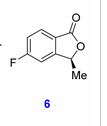
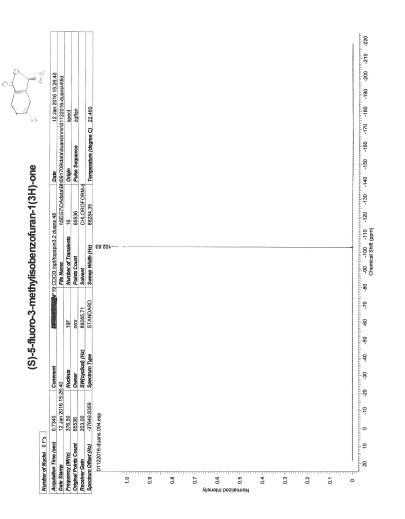
(S)-5-fluoro-3-methylisobenzofuran-1(3H)-one

str1
Preparation of (S)-5-Fluoro-3-methylisobenzofuran-1(3H)-one (6)
To a ................... Purity 99.9%, ee > 99.9%.
 
1H NMR (400 MHz, CDCl3): δ 7.88 (dd, J = 4.8, 8.4 Hz, 1 H), 7.21 (ddd, J = 2.0, 8.4, 8.8 Hz, 1 H), 7.12 (dd, J = 2.0, 8.8 Hz, 1 H), 5.53 (q, J = 6.4 Hz, 1 H), 1.63 (d, J = 6.4 Hz, 3 H) ppm;
 
13C NMR (100.6 MHz, CDCl3): δ 169.1, 166.5 (d, JCF = 256.6 Hz), 153.8 (d, JCF = 9.1 Hz), 128.0 (d, JCF = 10 Hz), 121.8, 117.2 (d, JCF = 24.1 Hz), 108.9 (d, JCF = 25.2 Hz), 77.0, 20.2 ppm;
 
19F NMR (376.5 MHz, CDCl3): δ −102.8 ppm.
 
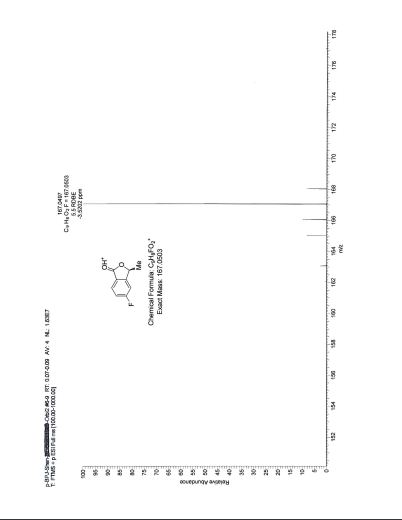
HRMS: Calcd for C9H8O2F (M + H)+: 167.0503. Found: 167.0497.
Developing an Asymmetric Transfer Hydrogenation Process for (S)-5-Fluoro-3-methylisobenzofuran-1(3H)-one, a Key Intermediate to Lorlatinib
Chemical Research and Development and Analytical Research and Development, Pfizer Worldwide Research and Development, Eastern Point Road, Groton, Connecticut 06340, United States
Org. Process Res. Dev., Article ASAP
DOI: 10.1021/acs.oprd.7b00187
 
 
Abstract Image
Synthesis of (S)-5-fluoro-3-methylisobenzofuran-1(3H)-one (6), a key intermediate to lorlatinib, is described. A few synthetic methodologies, that is, boron reduction, enzymatic reduction, asymmetric hydrogenation, and asymmetric transfer hydrogenation, were evaluated for the chiral reduction of the substituted acetophenone intermediate (8). A manufacturing process, on the basis of the asymmetric transfer hydrogenation, was developed. This process was successfully scaled up to prepare 400 kg of 6.
str1 str2 str3 str4
1H AND 13C NMR PREDICT

Thursday, 20 July 2017

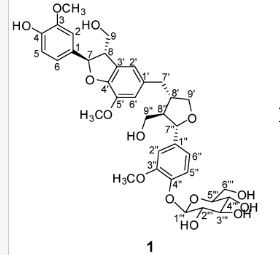
(7R, 8S, 8′S, 7″S, 8″R)-abiesol A 4″-O-β-d-glucopyranoside, capselloside.

(7R, 8S, 8′S, 7″S, 8″R)-abiesol A 4″-O-β-d-glucopyranoside, and it was named capselloside.
Capselloside (1): Brownish gum; [α]25D −34.0 (c = 0.05, MeOH); UV (MeOH) λmax (log ε) 280 (1.4), 228 (3.3), 214 (3.1) nm; IR (KBr) νmax 3261, 2946, 2816, 1638, 1489, 1261 cm−1; CD (MeOH) λmax (Δ ε) 291 (−), 280 (−) 257 (−) 230 (−) 223 (+); 1H (700 MHz) and 13C (175 MHz) NMR data, see Table 1; HR-FABMS (positive-ion mode) m/z: 723.2626 [M + Na]+ (calcd. for C36H44O14Na, 723.2629).
Compound 1 was obtained as a brownish gum. The molecular formula was established as C36H44O14using HR-FABMS, which showed a positive ion [M + Na]+ at m/z: 723.2626 (calcd. for C36H44O14Na, 723.2629, so the molecular formula was deduced to be C36H44O14.
The 1H-NMR spectrum of 1 revealed the presence of two 1,3,4-trisubstituted aromatic rings (δH 7.16 (d, J = 8.3 Hz, H-5′′), 7.15 (d, J = 8.2 Hz, H-5), 7.05 (d, J = 1.7 Hz, H-2), 7.01 (d, J = 1.7 Hz, H-2′′), 6.95 (dd, J = 8.2, 1.7 Hz, H-6), and 6.90 (dd, J = 8.2, 1.7 Hz, H-6″)), a 1,3,4,5-tetrasubstitued aromatic ring (δH 6.76 (s, H-6′), 6.78 (s, H-2′)), two oxygenated methines (δH 5.58 (d, J = 5.9 Hz, H-7) and 4.85 (m, H-7′′)), two oxygenated methylenes (δH 3.85 (m, H-9b), 3.78 (m, H-9a), and 3.88 (m, H-9′′a), 3.68 (dd, J = 10.9, 6.7 Hz, H-9b′′)), a methylene 2.96 ((dd, J = 13.5, 5.0 Hz, H-7′a), and 2.57 (dd, J = 13.3, 11.0 Hz, H-7′b)), three methines (δH 3.48 (m, H-8), 2.75 (sep, J = 6.5, 5.5 Hz, H-8′), and 2.38 (quin, J = 6.9 Hz, H-8″)), three methoxy groups (δH 3.88 (s, 3-OCH3), 3.87 (s, 5′-OCH3) and 3.84 (s, 3′′-OCH3)), and a glucopyanosyl unit (δH 4.91 (d, J = 7.3 Hz, H-1′′′), 3.69 (m, H-6′′′), 3.51 (m, H-2′′′), 3.41 (overlap, H-4′′′, 5′′′) and 3.39 (m, H-3′′′).
The 13C-NMR spectrum displayed 36 carbon signals, including 18 aromatic carbons δC 151.1 (C-3″), 147.9 (C-4′, 3′), 147.8 (C-3), 147.5 (C-4, 4″), 145.5 (C-5′), 139.7 (C-1″), 135.7 (C-1), 134.9 (C-1′), 119.7 (C-6″), 119.5 (C-6), 118.4 (C-6′), 118.2 (C-5″), 118.1 (C-5), 114.7 (C-2′), 111.5 (C-2″) and 111.3 (C-2), three oxygenated carbons δC 88.6 (C-7), 83.9 (C-7″), and 73.5 (C-9′), three methylene carbons δC 65.1 (C-9), 60.5 (C-9″), 33.9 (C-7′) and three methine carbons δC55.7 (C-8), 54.2 (C-8″), 44.0 (C-8′), and, three methoxy carbons (δC 56.9 and 56.8 (×2)), and glucose carbons δc 103.1 (C-1′′′), 78.5 (C-3′′′), 78.4 (C-5′′′), 75.1 (C-2′′′), 71.6 (C-4′′′), and 62.6 (C-6′′′) (Table 1).
Table 1. 1H (700 MHz) and 13C (175 MHz) NMR data of 1 in methanol-d4 (δ in ppm) a.
 
PositionδC, TypeδH (J in Hz)
1135.7, C 
2111.3, CH7.05, d (1.7)
3147.8, C 
4147.5, C 
5118.1, CH7.15, d (8.2)
6119.5, CH6.95, dd (8.2, 1.7)
788.6, CH5.58, d (5.91)
855.7, CH3.48, m
965.1, CH2 
a 3.78, m
b 3.85, m
1′134.9, C 
2′114.7, CH6.78, s
3′147.9, C 
4′147.9, C 
5′145.5, C 
6′118.4, CH6.76, s
7′33.9, CH2 
a 2.96, dd (13.5, 5.0)
b 2.57, dd (13.3, 11.0)
8′44.0, CH2.75, sep (6.5, 5.5)
9′73.5, CH2 
a 3.78, m
b 4.05, dd (8.3, 6.6)
1″139.7, C 
2″111.5, CH7.01, d (1.7)
3″151.1, C 
4″147.5, C 
5″118.2, CH7.16, d (8.3)
6″119.7, CH6.90, dd (8.2, 1.7)
7″83.9, CH4.85, overlap
8″54.2, CH2.38, quin (6.9)
9″60.5, CH2 
a 3.88, m
b 3.68, dd (10.9, 6.7)
Glc-1′′′103.1, CH4.91, d (7.3)
2′′′75.1, CH3.51, m
3′′′78.5, CH3.39, m
4′′′71.6, CH3.41, m
5′′′78.4, CH3.41, m
6′′′62.6, CH3.69, overlap
OCH3 (3″)56.93.84, s
OCH3 (3)56.83.88, s
OCH3 (5′)56.83.87, s
a The assignments were based on HSQC and HMBC experiments.
The 1H- and 13C-NMR spectra (Table 1) were very similar to those of abiesol A [17], except for the presence of a glucose unit in 1. The positions of three methoxy groups were confirmed as 3-OCH3 (δH3.88)/C-3 (δC 147.8), 5′-OCH3 (δC 3.87)/C-5′ (δC 145.5), and 3″-OCH3 (δH 3.84)/C-3″ (δC 151.1). HMBC correlation (H-1′′′ to C-4″) indicated that a D-glucose moiety was linked to C-4″ (Figure 2a), and identified the β form by the coupling constant (J = 7.3 Hz) [18]. The stereochemistry of 1 was assigned on the basis of examination of the CD spectrum in combination with the NOESY experiment. The absolute configurations of C-7 and C-8 were confirmed as 7R and 8S from the positive Cotton effect at 223 nm and the negative effect at 245 and 291 nm in the CD spectrum [19]. The absolute configurations of C-8′/C-7″/C-8″ were identified as 8′S, 7″S and 8R from the negative Cotton effect at 231 nm and 280 nm, respectively (Figure S8, Supplementary Materials) [19]. HMBC correlations and NOESY cross-peaks (Figure 2) reconfirmed the suggested structure of 1. The enzymatic hydrolysis of 1 afforded d-glucose, which was identified by the sign of the specific rotation [α]25D +48.2 (c = 0.03, H2O) and by co-TLC (CHCl3:MeOH:H2O = 2:1:0.1; Rf = 0.21) [20] and the aglycone 1a, which was identified by 1H-NMR and MS data [17]. Thus, the structure of 1 was determined as (7R, 8S, 8′S, 7″S, 8″R)-abiesol A 4″-O-β-d-glucopyranoside, and it was named capselloside.
Molecules 22 01023 g002
Figure 2. Key 1H-1H COSY, HMBC (a) and NOESY (b) correlations of 1.
 
 
Molecules201722(6), 1023; doi:10.3390/molecules22061023
Article
Phenolic Glycosides from Capsella bursa-pastoris (L.) Medik and Their Anti-Inflammatory Activity
Joon Min Cha 1, Won Se Suh 1, Tae Hyun Lee 1, Lalita Subedi 2,3, Sun Yeou Kim 2,3 and Kang Ro Lee 1,*
1
Natural Products Laboratory, School of Pharmacy, Sungkyunkwan University, Suwon 16419, Korea
2
Gachon Institute of Pharmaceutical Science, Gachon University, 191 Hambakmoero, Yeonsu-gu, Incheon 21936, Korea
3
College of Pharmacy, Gachon University, 191 Hambakmoero, Yeonsu-gu, Incheon 21936, Korea
*
Correspondence: Tel.: +82-31-290-7710; Fax: +82-31-290-7730
Received: 16 May 2017 / Accepted: 18 June 2017 / Published: 20 June 2017

성균관대학교 로고

Image result for Gachon Institute of Pharmaceutical Science, Gachon University,

Abstract:

A new sesquilignan glycoside 1, together with seven known phenolic glycosides 28 were isolated from the aerial parts of Capsella bursa-pastoris. The chemical structure of the new compound 1 was elucidated by extensive nuclear magnetic resonance (NMR) data (1H- and 13C-NMR, 1H-1H correlation spectroscopy (1H-1H COSY), heteronuclear single-quantum correlation (HSQC), heteronuclear multiple bond correlation (HMBC), and nuclear overhauser effect spectroscopy (NOESY)) and HR-FABMS analysis. The anti-inflammatory effects of 18 were evaluated in lipopolysaccharide (LPS)-stimulated murine microglia BV-2 cells. Compounds 4 and 7 exhibited moderate inhibitory effects on nitric oxide production in LPS-activated BV-2 cells, with IC50 values of 17.80 and 27.91 µM, respectively.
Keywords:
Capsella bursa-pastoris; Cruciferae; sesquilignan glycoside; anti-inflammatory
 
str1
 
/////////capselloside, nmr, cosy