DR ANTHONY MELVIN CRASTO,WorldDrugTracker, helping millions, A 90 % paralysed man in action for you, I am suffering from transverse mylitis and bound to a wheel chair, With death on the horizon, nothing will not stop me except God................DR ANTHONY MELVIN CRASTO Ph.D ( ICT, Mumbai) , INDIA 25Yrs Exp. in the feld of Organic Chemistry,Working for GLENMARK GENERICS at Navi Mumbai, INDIA. Serving chemists around the world. Helping them with websites on Chemistry.Million hits on google, world acclamation from industry, academia, drug authorities for websites, blogs and educational contribution

Sunday, 14 September 2014

Methyl 2-(but-3-en-1-yl)oxazole-4-carboxylate


Inline image 5


Methyl 2-(but-3-en-1-yl)oxazole-4-carboxylate

: Rf 0.39 (80% EtOAc in PE);

 IR (neat, cm-1): 2955, 1733, 1642, 1586, 1437, 1322, 1196, 1142, 1109, 1001, 917, 805, 768; 


1H NMR (500 MHz, CDCl3): 
δ = 8.13 (1H, s; H3), 
5.81 (1H, tdd, J = 6.5, 10.1, 17.0; H7), 
5.05 (1H, qd, J = 1.4, 17.0; H8a), 
4.99 (1H, qd, J =1.4, 10.1; H8b), 
3.90 (3H, s; H9), 2.90 (2H, t, J = 7.8; H5), 
2.52 (2H, tdd, J = 1.4, 6.5, 7.8; H6); 

13C NMR (125 MHz, CDCl3): 
δ = 165.2 (C4), 161.7 (C1), 143.7 (C3), 136.0 (C7), 133.1 (C2), 116.2 (C8), 52.1 (C9), 30.7 (C6), 
27.5 (C5); 


HRMS (ESI) calculated for C9H12NO3+ [M+H]+ 182.0772, found 182.0801.
...................................................................................

DR ANTHONY MELVIN CRASTO
ANTHONY MELVIN CRASTO
MY BLOGS ON MED CHEM
.......................................................................
DR ANTHONY MELVIN CRASTO Ph.D
MOBILE-+91 9323115463
GLENMARK SCIENTIST ,  INDIA
web link
アンソニー     安东尼   Энтони    안토니     أنتوني
blogs are 
 MY CHINA, VIETNAM  AND JAPAN BLOGS
ICELAND, RUSSIA, ARAB
GROUPS
you can post articles and will be administered by me on the google group which is very popular across the world
shark

feder-0005.gif from 123gifs.euamcrasto@gmail.com


(R)-2,5,5-Trimethyl-2-(oxiran-2-ylmethyl)-1,3-dioxane

Inline image 1

(R)-2,5,5-Trimethyl-2-(oxiran-2-ylmethyl)-1,3-dioxane

Rf 0.24 (PE: Et2O 5:1);

[α]D25 +8.5 (c 0.43, CHCl3);

 IR (neat, cm-1): 3052, 2955, 2984, 2869, 1474, 1412, 1377, 1363, 1349, 1309, 1244, 1211, 1191, 1168, 1121, 1041, 1023, 951, 908, 837, 798, 759, 679;

1H NMR (400 MHz, CDCl3):
δ = 3.28 (2H, d, J = 11.9; H6a, 7a),
3.14 (2H, d, J = 11.9; H6b,7b),
2.78 (1H, dddd, J = 6.3, 5.1, 4.3, 2.7; H2),
2.43 (1H, dd, J = 5.2, 4.3; H1a),
2.15 (1H, dd, J = 5.2, 2.7; H1b),
1.62 (1H, dd, J = 14.3, 5.1; H3a),
1.57 (1H, dd, J = 14.3, 6.3; H3b),
1.15 (3H, s; H5), 0.74 (3H, s; H9),
0.60 (3H, s; H10);

13C NMR (100 MHz, CDCl3):
δ = 97.4 (C4), 69.5 (C6), 69.5 (C7), 47.5 (C2), 45.5 (C1),
40.8 (C3), 29.2 (C8), 22.1 (C9), 21.7 (C10), 19.8 (C5);

HRMS (ESI) calc. for C10H19O3+ [M+H]+ 187.1329, found 187.1321.

Saturday, 13 September 2014

(R)-2-((2-Methyl-1,3-dithian-2-yl)methyl)oxirane

Inline image 1
Inline image 2

Rf 0.24 (PE: Et2O 5:1); 

[α]D25 +4.5 (c 0.33, CHCl3); 

IR (neat, cm-1): 3046, 2909, 2828, 1480, 1445, 1419, 1373, 1277, 1257, 1239, 
1125, 1086, 1061, 1000, 959, 938, 906, 864, 848, 826, 757, 723, 678, 661; 

1H NMR (400 MHz, CDCl3): 
δ = 3.05 (1H, dddd, J = 6.4, 4.7, 4.1, 2.7; H2), 
2.84-2.69 (4H, m; H6,7),
2.65 (1H, dd, J = 5.1, 4.1; H1a),
 2.39 (1H, dd, J = 5.1, 2.7; H1b), 
2.12 (1H, dd, J = 14.7, 4.7; H3a), 
1.94 (1H, dd, J = 14.7, 6.4; H3b), 
1.93-1.75 (2H, m; H8), 1.57 
(3H, s; H5); 

13C NMR (100 MHz, CDCl3): δ = 48.6 (C2), 47.3 (C4), 46.1 (C1), 43.8 (C3), 28.0 (C5), 26.2 (C6), 
26.1 (C7), 24.6 (C8);

 HRMS (EI) calc. for C8H15OS2+ [M]+ 190.0481, found 190.0474; 

characterization data in 
agreement with the literature.1

Fürstner, A.; Kattnig, E.; Kelter, G.; Fiebig, H.-H. Chem.–Eur. J. 2009, 15, 4030-4043
Inline image 3

Tuesday, 9 September 2014

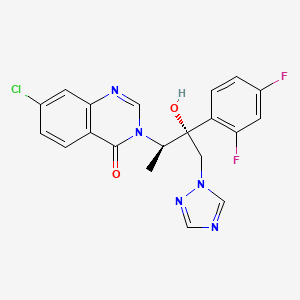
Albaconazole

Chemical structure for albaconazole

Albaconazole

Also known as: UNII-YDW24Y8IAB; UR-9825; 187949-02-6; UR 9825, W-0027
Molecular Formula: C20H16ClF2N5O2   Molecular Weight: 431.823146
(1R,2R)-7-chloro-3-[2-(2,4-difluorophenyl)-2-hydroxy-1-methyl-3-(1H-1,2,4-triazol-1-yl)propyl]quinazolin-4(3H)-one
7-chloro-3-[(2R,3R)-3-(2,4-difluorophenyl)-3-hydroxy-4-(1,2,4-triazol-1-yl)butan-2-yl]quinazolin-4-one
J. Med. Chem.199841 (11), pp 1869–1882
DOI: 10.1021/jm9707277

A series of azole antifungal agents featuring a quinazolinone nucleus have been subjected to studies of structure−activity relationships. In general, these compounds displayed higher in vitro activities against filamentous fungi and shorter half-lives than the structures described in our preceding paper. The most potent products in vitro carried a halogen (or an isostere) at the 7-position of the quinazolinone ring. Using a murine model of systemic candidosis, oral activity was found to be dependent on hydrophobicity, which, in turn, modulated the compound’s half-life. The 7-Cl derivative, (1R,2R)-7-chloro-3-[2-(2,4-difluorophenyl)-2-hydroxy-1-methyl-3-(1H-1,2,4-triazol-1-yl)propyl]quinazolin-4(3H)-one (20, UR-9825), was selected for further testing due to its high in vitro activity, low toxicity, good pharmacokinetic profile, and ease of obtention. Compound 20 is the (1R,2R) isomer of four possible stereoisomers. The other three isomers were also prepared and tested. The enantiomer (1S,2S) and the (1R,2S) epimer were inactive, whereas the (1S,2R) epimer retained some activity. In vitro 20 was superior to fluconazole, itraconazole, SCH-42427, and TAK-187 and roughly similar to voriconazole and ER-30346. In vivo, 20 was only moderately active in a mouse model of systemic candidosis when administration was limited to the first day. This was attributed to its short half-life in that species (t1/2 = 1 h po). Protection levels comparable to or higher than those of fluconazole, however, were observed in systemic candidosis models in rat and rabbit, where the half-life of the compound was found to be 6 and 9 h, respectively. Finally, 20 showed excellent protection levels in an immunocompromised rat model of disseminated aspergillosis. The compound showed low toxicity signs when administered to rats at 250 mg/kg qd or at 100 mg/kg bid during 28 days.
 (1R,2R)-7-Chloro-3-[2-(2,4-difluorophenyl)-2-hydroxy-1-methyl-3-(1H-1,2,4-triazol-1-yl)propyl]quinazolin-4(3H)-one (20, UR-9825). Precipitated from EtOH/H2O (66% yield from amine 11):  white amorphous solid;
mp 93−110 °C (wide range);
IR (KBr) ν 1675, 1601, 1554, 1498 cm-1;
1H NMR (300 MHz, CDCl3) 8.58 (s, 1H, NCH-N), 8.26 (d, J = 8.6, 1H, arom), 8.11 (d, J = 5.7, trace rotamer), 7.76 (s, 2H, triazol),
7.74 (d, J = 5.3, 1H, arom), 7.5 (m, 2H, arom), 7.10 (s, trace rotamer), 6.9−6.7 (m, 2H, arom),
5.91 (dq, Jd = 2, Jq = 7, 1H, MeCH), 5.54 (d, J = 2, 1H, OH),
5.15 (d, J = 14.2 1H, CH(H)), 4.9−4.7 (m, trace rotamer), 4.30 (d, trace rotamer), 3.99 (d, J = 14.2, 1H, CH(H)),
1.46 (d, J = 6.9, trace rotamer), 1.29 (d, J = 7, 3H, CHMe);
GC−MS 224 (Tr-CH2COHAr, C10H8F2N3O), 208 (group N-ethylheterocycle, C10H9ClN2O);
[α]D −8.0° (c 1, CHCl3).
Chiral HPLC (column, CicloBond SN 1; eluent, MeOH: Et3NHOAc in H2O at pH7 1:1; retention times:  (S,S) (74tR 12.6 min; (R,R) (20tR 13.7 min). Area ratio:  0.01:99.99.
Anal. (C20H16ClF2N5O2) C, H, N. 

synthesis at

Saturday, 6 September 2014

GENISTIN


Genistin

GENISTIN
C21H20O10

432.38

CAS Number:529-59-9   
lmax (MeOH) : 326 (3.70), 261 (4.40)


(400 MHz, DMSO-d6) δ : 12.94 (1H, s, OH-5), 9.61 (1H, s, OH-4'), 8.43 (1H, s, H-2), 7.40 (2H, d, J = 8.6 Hz, H-2', 6'), 6.82 (2H, d, J = 8.6 Hz, H-3', 5'), 6.72 (1H, d, J = 2.2 Hz, H-8), 6.47 (1H, d, J = 2.2 Hz, H-6), 5.41 (1H, br s, OH-2"), 5.14 (1H, br s, OH-3"), 5.06 (1H, d, J = 7.3 Hz, H-1"), 4.61 (1H, br s, OH-6"), 3.71 (1H, m, H-6"), 3.46 (2H, m, H-5", 6"), 3.27 (2H, m, H-2", 3"), 3.17 (1H, t, J = 8.1 Hz, H-4")


(100 MHz, DMSO-d6) δ : 180.49 (C-4), 163.00 (C-7), 161.63 (C-5), 157.49 (C-9), 157.21(C-4'), 154.54 (C-2), 130.15 (C-2', 6'), 122.55 (C-3), 120.98 (C-1'), 115.08 (C-3', 5'), 106.07 (C-10), 99.83 (C-1"), 99.56 (C-6), 94.51 (C-8), 77.18 (C-5"), 76.40 (C-3"), 73.06 (C-2"), 69.58 (C-4"), 60.61 (C-6")


Genistin is an isoflavone found in a number of dietary plants like soy and kudzu. It was first isolated in 1931 from the 90% methanol extract of a soybean meal, when it was found that hydrolysis with hydrochloric acid produced 1 mole each of genisteinand glucose.[1] Chemically it is the 7-O-beta-D-glucoside form of genistein and is the predominant form of the isoflavonenaturally occurring in plants. In fact Studies in the 1970s revealed that 99% of the isoflavonoid compounds in soy are present as their glucosides. The glucosides are converted by digestive enzymes in the digestive system to exert their biological effects. Genistin is also converted to a more familiar genistein, thus, the biological activities including antiatherosclerotic, estrogenic andanticancer effects are analogous.

Metabolism

When ingested along the diet, genistin is readily converted to its aglycone form, genistein. It is hydrolyzed by removing thecovalently bound glucose to form genistein and that genistein is the form of the compound that is absorbed in the intestine and is the form responsible for the biological activities of the isoflavone. The digestive metabolism was first demonstrated in 2002 that the gut microflora played a large role in the conversion of genistin to genistein.[2] It was later found that enzymes present in the human small intestine and liver also have the ability to convert the isoflavoneHydrolysis actually starts very quickly in thedigestive system once genistin is ingested, conversion begins in the mouth and then continues in the small intestine. Moreover, both human saliva and the intestinal cell-free extract from mice can cause the complete conversion.[2]

Biological importance

Estrogenic activity[

Genistin, like genistein, is a phytoestrogen as it was shown to stimulate estrogen-dependent breast cancer cell growth in vivo. At a concentratio of 1200 ppm, genistin caused significant increase of growth of breast tumors (MCF-7)cellular proliferation and estrogen-responsive pS2 gene expression in mice. Removal of genistin or genistein from the diet caused tumors to regress.[3]

Antiviral activity

Genistin and other isoflavones are demonstrated to be bioactive within the neonatal intestine and may reduce the severity ofrotavirus infections; genistin alone shows inhibition of the viral infectivity by 40-60%.[4]

Bone metabolism

In vitro study have shown that both genistin and genistein are capable of enhancing bone metabolism in the femoral-metaphyseal tissues of elderly rats.[5] The presence of genistein or genistin in the tissue culture caused a significant increase in alkaline phosphatase activitydeoxyribonucleic acid (DNA) and calcium contents. The effect of genistein was greater than that of genistin. It is also revealed that genistin has a strong bone loss preventive activity on experimental rats, and is especially enhaced by combination withfructooligosaccharides.[6] The amount of new bone produced by grafting genistin in collagen matrix was compared to the bone produced by collagen matrix alone in New Zealand White rabbits, and was observed that genistin caused significant increase in bone formation.[7]

References

  1. Jump up^ Walter ED (1941). "Genistin (an isoflavone glucoside) and its aglucone, genistein, from soybeans". J Am Chem Soc 62 (12): 3273–3276. doi:10.1021/ja01857a013.
  2. Jump up to:a b Coldham NG, Darby C, Hows M, King LJ, Zhang AQ, Sauer MJ (2001). "Comparative metabolism of genistin by human and rat gut microflora: detection and identification of the end-products of metabolism". Xenobiotica 22 (10): 45–62. doi:10.1080/00498250110085809PMID 11820509.
  3. Jump up^ Allred CD, Ju YH, Allred KF, Chang J, Helferich WG (2001). "Dietary genistin stimulates growth of estrogen-dependent breast cancer tumors similar to that observed with genistein".Carcinogenesis. 22 (10): 1667–1673. doi:10.1093/carcin/22.10.1667PMID 11577007.
  4. Jump up^ Donovan SM, Andres A, Mathai RA, Kuhlenschmidt TB, Kuhlenschmidt MS (2009). "Soy formula and isoflavones and the developing intestine". Nutr Rev. 67 (S2): 192–200.doi:10.1111/j.1753-4887.2009.00240.xPMID 19906223.
  5. Jump up^ Yamaguchi M, Gao YH (January 1998). "Anabolic effect of genistein and genistin on bone metabolism in the femoral-metaphyseal tissues of elderly rats: the genistein effect is enhanced by zinc". Mol. Cell. Biochem. 178 (1-2): 377–82. doi:10.1023/A:1006809031836PMID 9546622.
  6. Jump up^ Hooshmand S, Juma S, Arjmandi BH. (2010). "Combination of Genistin and Fructooligosaccharides Prevents Bone Loss in Ovarian Hormone Deficiency". J Med Food. [Epub ahead of print] (2): 320–5. doi:10.1089/jmf.2009.0059PMID 20132047.
  7. Jump up^ Wong RW, Rabie AB (2010). "Effect of genistin on bone formation". Front Biosci (Elite Ed) 2 (1): 764–770. PMID 20036920.

External links


http://www.herbdb.co.kr/herb/dbsearch3/separation_view.asp?key=253

Genistin
Genistin.svg
Identifiers
CAS number529-59-9 Yes
PubChem5281377
ChemSpider4444736 Yes
ChEBICHEBI:27514 Yes
ChEMBLCHEMBL486625 Yes
Jmol-3D imagesImage 1
Properties
Molecular formulaC21H20O10
Molar mass432.37 g/mol
Except where noted otherwise, data are given for materials in their standard state (at 25 °C (77 °F), 100 kPa)
Reference:
1. J.C.S. Perkin 1, 1998, 2481-2484.
2. Phytochemistry, 2002, 60, 205-211.
3. Carcinogenesis., 2001, 22(10), 1667-1673.
4. Mol. Cell. Biochem., 1998, 178 (1-2), 377-382.